His Chapels
MAIN ALTARS, CHAPELS AND THE VALUE OF COLONIAL INCLUSION
Chapel of the Blessed Sacrament and the Silver Tabernacle (1804)
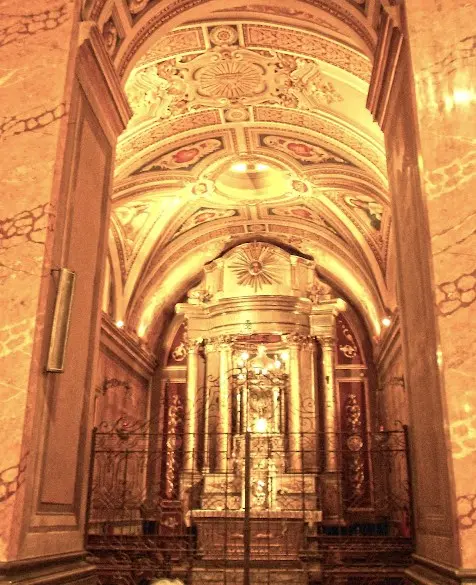
Located at the end of the right side aisle, in the most secluded corner of the Cathedral, it functions architecturally as a church within the church. It houses one of the most valuable works of silversmithing in South America: the finely crafted silver Tabernacle of 1804, made with metal extracted from the mines of Upper Peru. The Cathedral's fabric records of the time reveal a milestone of social inclusion: the piece was designed by master Manuel Garay and executed by silversmith Cayetano Álvarez, both explicitly recorded in the colonial books as members of the community of "pardos" (people of African descent).
To finance the kilos of silver needed, the Church organized a donation contest among the parishes of the province: the parish that contributed the most metal would receive in exchange the old Jesuit altarpiece of carved cedar, of Upper Peruvian craftsmanship and dating from the late 17th century, which the Cathedral was going to remove from that area. The prize went to the historic Villa de Tulumba. The altarpiece first stood in its humble church, now in ruins, and today can be admired and venerated in the Parish Church of Our Lady of the Rosary, a Marian Shrine since 1988, whose cornerstone was blessed by Bishop Esquiú on February 15, 1882.
The chapel also preserves a marble Tabernacle, two votive lamps, and two large paintings, copies of "Jesus in the Garden of Olives" and "The Agony of Saint Jerome."
The Penitential Chapel, the Bishops' Crypt and the Founding Virgin
Behind the Chapel of the Blessed Sacrament are the Penitential Chapel and, beneath it, the Burial Crypt where the remains of the prelates of the diocese rest. Engraved in white marble are the names of all the bishops and archbishops of Córdoba, the dates of their passing, and the places where they await the glory of the Resurrection.
In an elevated niche is kept the oldest historical relic of the province: the "Founding Virgin" (Our Lady of the Assumption), the small image that Jerónimo Luis de Cabrera brought with him when he founded the city on July 6, 1573. According to tradition, it remained in the hands of one of the first settlers and was passed down through the male line. Upon the death of the last of them, Pedro Salas Griera, his wife, Dalinda W. de Salas Griera, entrusted it to the Archdiocese. Cardinal Primatesta presented the image with a pectoral cross and chain.
Chapel of Our Lady of Nieva (La Soterraña)
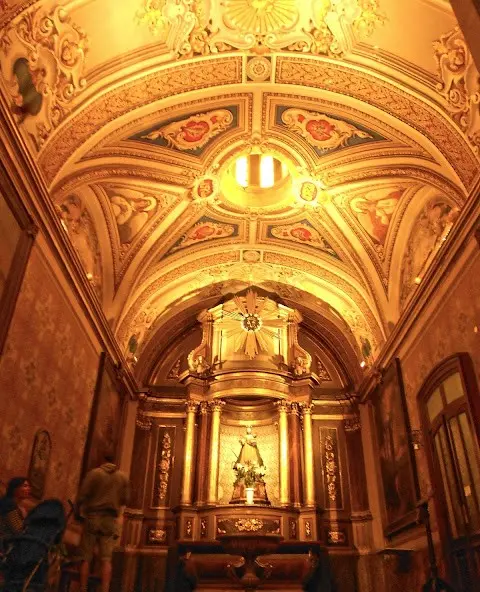
Located in the left side aisle, it houses a historic image brought from Spain in 1794, funded by the brothers Ambrosio and Gregorio Funes.
Its origin is fascinating. On February 9 of that year, Andrés Bartolomé Pérez, on behalf of the Bishop of Córdoba, Ángel Mariano Moscoso, presented to the prior of the Convent of Santa María la Real de Nieva, Fray Melchor de Santo Tomás, OP, a statue of Our Lady of Nieva with the Child Jesus. It was one vara tall (about 84 cm), with a blue-ground chasuble and ornamentation in various colors, and had been made by an image carver from Madrid as a faithful copy of the image venerated in that Dominican convent. The image arrived in Córdoba in December 1794: it was welcomed at the Calicanto and carried in procession to the Cathedral.
The sculpture is of exceptional international value: the original image in Segovia, which this piece "touched" to certify its fidelity, was completely destroyed in a fire on June 8, 1900. The carving preserved in Córdoba is therefore one of the very few faithful colonial copies that survive in the world.
On Christmas Eve 1795, Pedro Lucas de Allende requested that Our Lady of Nieva be named Patroness and Protector of Córdoba against storms. The Cabildo (city council) agreed on December 27, with the Bishop's approval, but Governor Intendant Sobremonte opposed it. Father Miguel Calixto del Corro, a prominent figure of the University and the Church and one of Córdoba's deputies to the Congress of Tucumán in 1816, recounted that the Governor's refusal was overcome when a violent storm struck his house and destroyed only a clock.
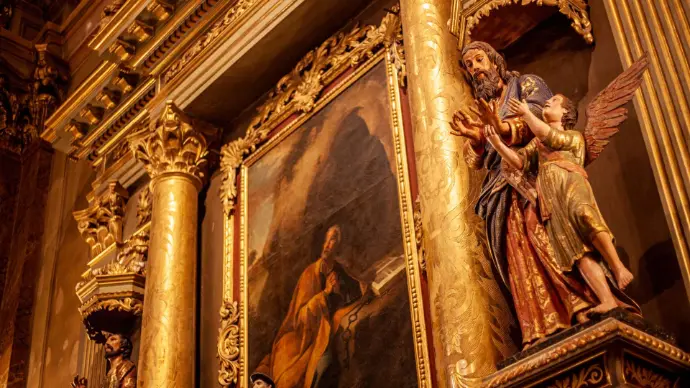
The beautiful altarpiece that frames the image is the work of master Manuel Garay, who directed the carpenter Inocencio in its construction; the two small angels in the attic are by an anonymous sculptor. It is made up of Corinthian pilasters and columns that enclose a space crowned by an inner dome. On October 19, 1797, Bishop Moscoso blessed the altarpiece and the image, and decreed that the liturgical feast of Our Lady of the Soterraña of Nieva be celebrated on the second Sunday of November.
The chapel is completed by four large paintings, commissioned by Bishop Moscoso from the Royal Academy of Fine Arts of San Fernando in Madrid, which tell the story of the devotion to Our Lady of Nieva: "The Virgin appears to the shepherd Pedro Amador"; "The Bishop of Segovia recovers from the slate quarry of Santa María (September 9, 1392) the image hidden in 714 to save it from the invaders"; "A farmer escapes death by invoking Our Lady of Nieva"; and "Protected by the Virgin's scapular, a peasant remains unharmed when struck by lightning."
On the south wall of this chapel rest the remains of Blessed Fray Mamerto Esquiú, OFM, a man of two worlds: a servant of his homeland, as the Argentine leader known as the "Orator of the Constitution," and a servant of the Church through his heroic virtues, beatified in 2021.
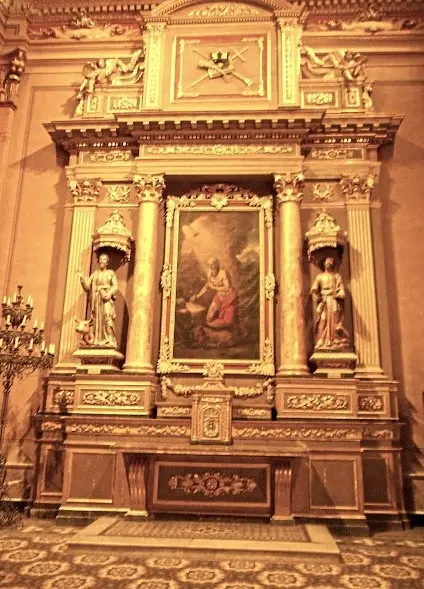
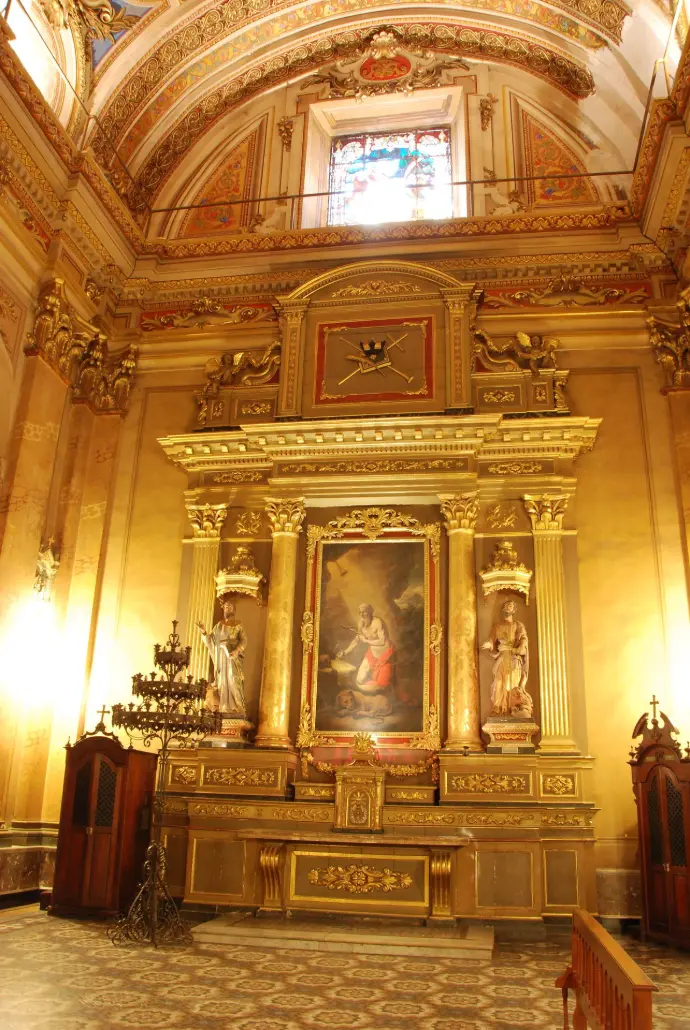
The other chapel altarpieces, made of gilded wood, vary according to their location and the period in which they were built. Ochre, gold, blue and garnet red predominate in their decoration.